Mysore After Dark: 97,000 Bulbs and the City That Glows
Mysore After Dark: 97,000 Bulbs and the City That Glows
Cut it close and you'll still make it. The bus from Bengaluru is scheduled for 4 PM; expressway traffic can easily push it past 6. Drop your bag at the hotel, skip the unpacking, and move toward the palace grounds — because on a Sunday evening, that's the only place to be.
In Mysore, Sunday evening means one thing.
By 6:45 PM the crowd is already thick — families on blankets, couples holding hands, chai vendors working fast, children darting between the ornamental gates. Everyone faces the same direction: toward the palace, which at that hour is still just a vast silhouette against a darkening sky.
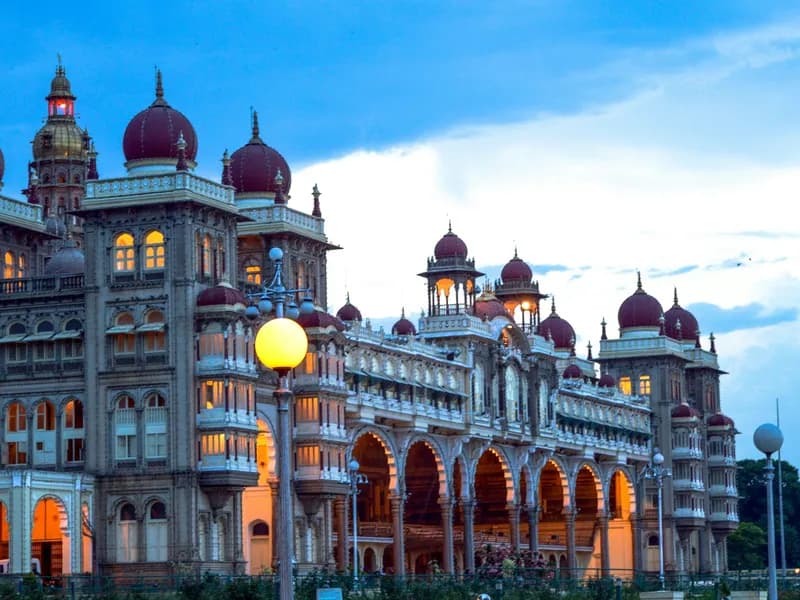
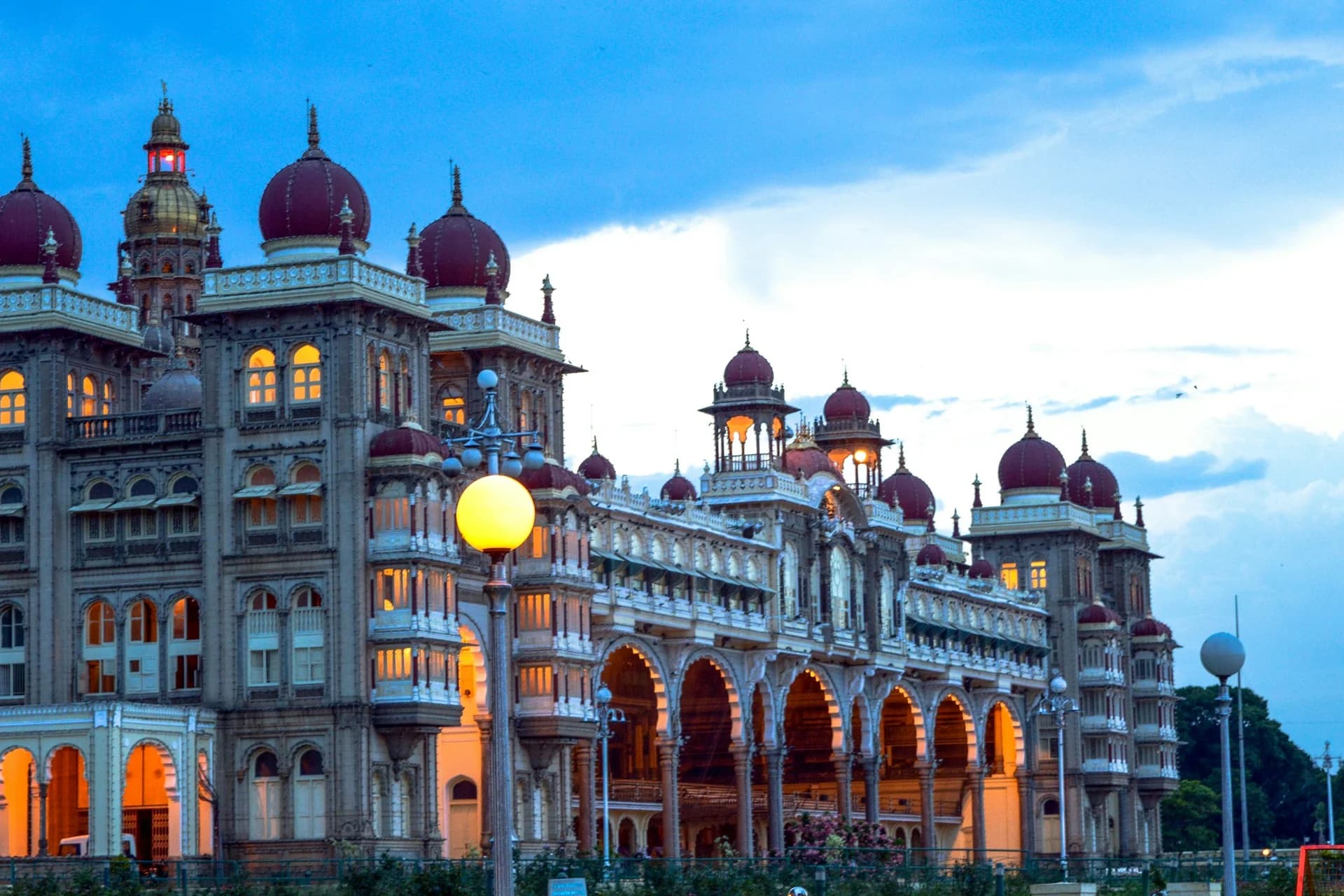
At 7:00 PM exactly, 97,000 light bulbs switch on at once.
Words don't quite reach it. The Indo-Saracenic architecture — domes, arches, pillars, the massive central tower — snaps into warm white outline against a purple sky. The building doesn't look illuminated. It looks like it's generating light from within, as if the marble and granite had been swapped for something luminous.
The crowd exhales together. Then come the phones — thousands of them, raised against the night, every screen holding a slightly different angle of the same impossible building.
The Palace Before the Lights
See Mysore Palace in daylight first and the contrast does the rest. Entry runs INR 200 for foreigners. No cameras inside — just your eyes.
The interior is overwhelming. The Durbar Hall carries an octagonal ceiling and cast-iron pillars. The private rooms hold carved rosewood furniture and floors polished to a mirror that throws back the stained-glass windows above. The golden throne — 200 kg of gold, displayed only during Dasara — stays in its glass case the rest of the year, quietly promising its return.
Henry Irwin designed the palace in 1912, replacing an earlier structure that burned down. The style is Indo-Saracenic — a hybrid of Hindu temple forms, Islamic domes, and Rajput arches, filtered through a British architect's imagination. The result is unlike any other palace in India.
In daylight, the palace reads as a building: impressive, beautiful, historically significant. At night, under 97,000 bulbs, it becomes a statement. Mysore's Wadiyar dynasty ruled for over 500 years, and the illumination feels like the palace insisting: we're still here.
Devaraja Market at Dusk
Time your evening to pass through Devaraja Market on Sayyaji Rao Road before the lights. The 130-year-old market is winding down by then — and the dusk energy runs different from morning commerce.
The flower vendors are at their most dramatic in the fading light. Mountains of marigolds, jasmine ropes, roses — the colors deepen as the sun drops. The kumkum (vermillion powder) vendors keep their pyramids of red, orange, and yellow arranged like a painter's palette. The sandalwood shops release their scent into the cooling air.
Buy a string of jasmine for INR 20 and wear it on your wrist for the rest of the evening. The smell will follow you straight into the palace illumination.
Chamundi Hills After Hours
On a Monday — no palace illumination — point an auto-rickshaw up Chamundi Hills (INR 250). The Chamundeshwari Temple at the top runs its evening puja, oil lamps flickering inside the stone chamber.
The view is the reason to climb. From 1,065 meters, Mysore spreads below in a grid of lights. The palace sits dark on Mondays, but you can pick it out by sheer scale — a dark rectangle among the streetlights.
The descent on foot — 1,000 steps, 30 to 45 minutes down — is pure atmosphere. Scattered lamps light the stairs; other walkers carry flashlights. The Nandi bull statue at step 700 — 5 meters of black granite carved from a single rock — is barely visible, its massive form folding into the dark.
The Dasara Promise
Visit in February, outside Dasara season, and everyone tells you the same thing — palace guards, hotel staff, auto drivers alike: "You must come for Dasara."
Across the ten-day festival (September–October), the palace illumination runs every night. The Vijayadashami procession sends a gold-adorned elephant carrying the goddess's idol through the city. Wrestling matches, cultural performances, and exhibition grounds transform Mysore from a pleasant city into an event.
One Sunday illumination is enough to understand why travelers build an entire year around the festival.
Brindavan Gardens at Night
Save an evening for Brindavan Gardens, 19 km from Mysore. Entry is INR 75 for foreigners. The terraced botanical gardens are pleasant by day, but the musical fountain show (7–8 PM in winter) is the real draw.
The fountains dance to Bollywood hits and classical Karnataka songs. Colored lights shift through the water. The KRS Dam looms behind, massive and industrial, lending an unexpectedly powerful backdrop to the liquid choreography.
The show is kitschy — and that's part of the charm. Hundreds of families settle on the terraces, children pointing at the colored water, couples sharing popcorn. The collective enjoyment is genuine. Not ironic, not performative. Just people delighting in water and light.
The Afternoon Version
Mysore in the afternoon is a different creature. The city keeps a pace that Bengaluru, three hours away, has forgotten. Lunch at Hotel Siddhartha buys an unlimited veg meal for INR 120. Then the post-lunch stillness sets in: shops half-shuttered, streets quiet, the palace gardens empty but for a few readers on benches.
Walk over to St. Philomena's Cathedral — one of Asia's tallest churches, 53-meter twin spires in Neo-Gothic style. Built in 1936 and inspired by Cologne Cathedral, the interior is cool, dark, and silent. Stained glass depicting the Last Supper filters the afternoon light into colored panels across the stone floor.
Mysore's religious architecture doesn't discriminate. Hindu palaces, Sufi-inspired gardens, Neo-Gothic churches, ancient temples — the city holds them all with equal affection.
What Stays
Plenty of cities carry grander history. Delhi has more monuments. Jaipur has more color. Udaipur has a lake.
Mysore is the gateway to Coorg, just 120 km of winding roads into coffee country.
History lovers can push on from Mysore to Hampi, the Vijayanagara Empire's ruined capital.
But Mysore holds something the others don't — a quality of light. Not just the 97,000 bulbs, spectacular as they are. The morning light at Devaraja Market, the sunset light at Chamundi Hills, the fountain light at Brindavan, the stained-glass light at St. Philomena's. Mysore understands light the way some cities understand food or music.
For insider tips, read our Mysore travel tips.
The City of Palaces, they call it. The City of Light would fit just as well — but that name's already taken.
Come on a Sunday. See the palace at 7 PM. And bring your jasmine.