Six Days in Normandy: A Day-by-Day Route from Rouen to Mont-Saint-Michel
Six Days in Normandy: A Day-by-Day Route from Rouen to Mont-Saint-Michel
Here's the thing nobody tells you: Normandy doesn't have a centre. It's a loop, not a hub — so the best trips are drives, with a fresh bed every night or two and a car doing the heavy lifting. This is a six-day route that starts with Impressionists, works through the D-Day coast in the middle, and lands you on a tidal island abbey at the end, when the coaches have gone and the place is yours. Pick up a rental at Rouen's station or at CDG and go.
Day 1: Rouen — Monet's Cathedral and Joan of Arc
Start in Rouen, an hour and a bit from Paris by train and the gentlest possible on-ramp. Park once, garage the car, and don't touch it again till tomorrow — the medieval centre is all pedestrian and it's a 20-minute walk end to end.
Head to the Cathédrale Notre-Dame first, before the light flattens (free, 9AM-7PM, from 2PM on Mondays). Monet rented a room across this square and painted the west front thirty times in 1892-93; inside, a casket holds Richard the Lionheart's heart, and the cast-iron spire is the tallest in France at 151 m. Then the Gros-Horloge, a 14th-century astronomical clock straddling the street on a Renaissance arch — climb the belfry for about €7.50 (closed Mondays). Walk to Place du Vieux-Marché, where Joan of Arc was burned in 1431, marked now by a tall cross beside a church shaped like an upturned hull.
Lunch at Dame Cakes on rue Saint-Romain (a savoury tart and a slice of tarte normande, €20 — ask for the back garden, it butts up against the archbishop's wall and nobody knows it's there). Afternoon: the Musée des Beaux-Arts, free, which hangs a real Monet cathedral canvas six minutes' walk from the facade itself. Dinner at La Couronne on the market square — trading since 1345, plausibly the oldest inn in France, where Julia Child ate the sole meunière that rearranged the rest of her life. Order exactly that (€38). Yes it's touristy. Doesn't matter — and if this turns into the trip where you plan the days around the meals, the bouchons of Lyon are the obvious next chapter.
Day 2: The Alabaster Coast — Étretat's Arches, Then Honfleur
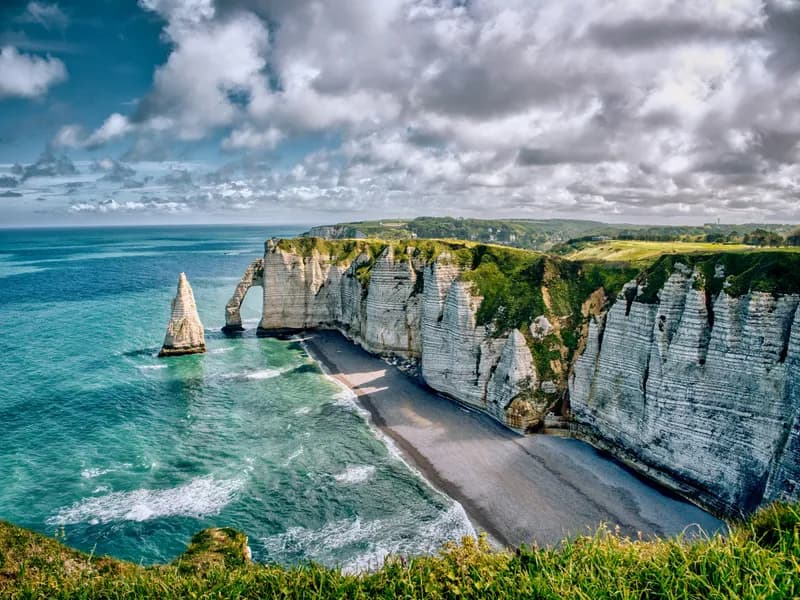
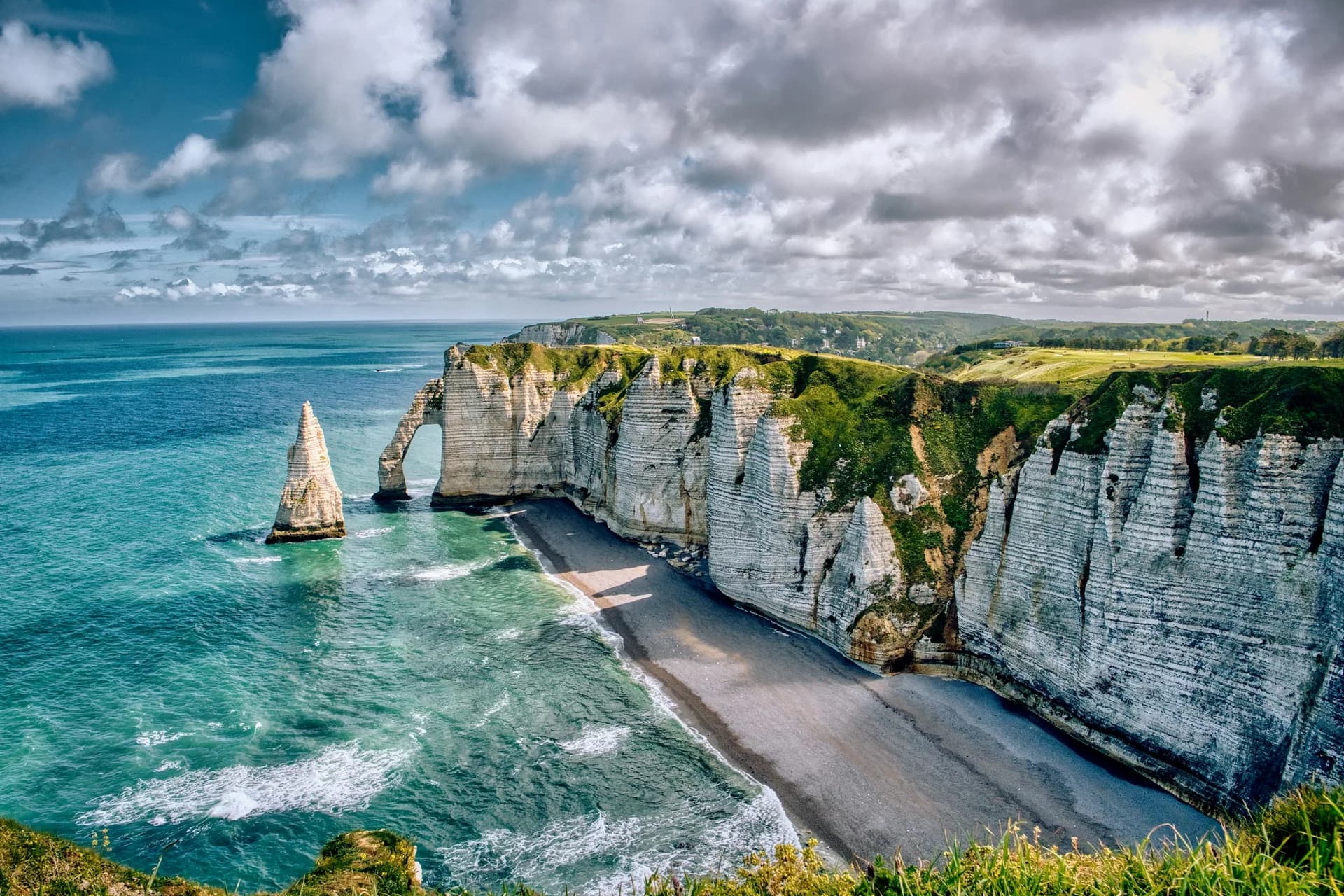
Collect the car and drive an hour and a quarter northwest to Étretat. Get there before the day-trippers land around 11 — the village lots fill by 10:30 in summer. Park on the Aval side (~€5) and take the steps at the south end of the shingle up to the Falaise d'Aval clifftop loop (about 90 minutes). From the top you get the Porte d'Aval arch and the 70-metre Aiguille needle from above, then a grass path along the golf course toward the bigger Manneporte. These are the cliffs Monet couldn't stop painting.
One rule. Check a tide table before you go near the beach below. The sea reaches the cliff base and the arches cut off your way back — it's precisely the trap it looks like.
Lunch under the timber market hall on Place Foch (galettes, moules, cider by the bowl, €12-18). Then drive south over the Pont de Normandie — a 2,141-metre span high over the Seine, €6.60 toll, ninety of the best seconds of driving in France — into Honfleur. Park at Parking Bassin; the centre's car-free. Wander the Vieux Bassin, duck into Sainte-Catherine (France's largest timber church, built by shipwrights as two upturned hulls), and eat at Le Bréard on rue du Puits (~€45) before walking the harbour after dark, when the tall slate houses have their lights on and the day boats have gone home.
Day 3: Caen's Memorial, Then Into Bayeux
Take a slow morning in Honfleur — the one lie-in of the week. Then an hour down the A13 to the Mémorial de Caen (~€20, opens 9AM, closed most of January). Do this before you go anywhere near a beach. It's built on top of a German command bunker and you walk down into it, and the story runs from the collapse of the 1918 peace through the occupation and the landings to the Cold War. Give it three hours; the coast assumes you already know all of it and explains none of it.
Then 30 minutes on to Bayeux, your base for the next three nights — we make the full case for basing here over Caen if you're weighing the two. It was the first French town liberated, on 7 June 1944, with not a bomb dropped — so the medieval centre is the real thing. Check in, then dinner at Le Pommier on rue des Cuisiniers (Norman classics, ~€30). One note for the morning: the famous Bayeux Tapestry is off view — the museum closed in September 2025 for a rebuild and the embroidery's on loan to London through 2027 — so don't build a day around it. Check bayeuxmuseum.com before you travel.
Day 4: D-Day — Pointe du Hoc, Omaha, and Colleville
The central sector, west to east, in roughly the order it happened. Be at Pointe du Hoc for the 9AM opening (free, 35 minutes from Bayeux). The ground is still cratered exactly as the naval shelling left it, and you can walk down into the bunkers — it's the one battlefield here your body understands without a caption.
Drive 12 km east to Omaha Beach; park at Saint-Laurent-sur-Mer beside Les Braves, the steel sculpture standing out in the surf, and walk the sand toward the Vierville draw. At low tide it's 300 metres from waterline to shingle — and that distance is the whole point of the day. Picnic from a Bayeux boulangerie (buy it on rue Saint-Jean before you leave, ~€6).
Afternoon: the Normandy American Cemetery at Colleville-sur-Mer (free, 9AM-5PM, to 6PM in summer). Bring photo ID — it's US federal soil and the gate is airport-grade. Do the visitor centre first, then the graves: 9,388 of them, aligned so the rows run true from any angle you stand at. Stay for the flag lowering and Taps at closing, then take the path down to the beach. Fifteen minutes west, La Cambe German cemetery is the quiet counterweight — 21,222 graves, most of the men 17, 18, 19. Dinner back in Bayeux at La Rapière, a 13th-century stone room (~€32). You won't feel like talking much, and nobody in this town has ever minded that.
Day 5: Gold Sector, Then West to the Abbey
A lighter morning. Longues-sur-Mer first (free, 20 minutes out) — the only German battery in Normandy with its original guns still in the casemates; walk out to the cliff observation post used in The Longest Day. Then Arromanches, where the Allies towed a harbour across the Channel and assembled it in twelve days. Six concrete caissons still sit in the bay; at low tide you can walk out and put a hand on one. Climb the cliff path east of town — that's where the scale of it finally lands. The Musée du Débarquement on the seafront (~€12, rebuilt in 2023) fills in the how.
Then drive southwest (about 1h40) to Mont-Saint-Michel. Here's the move that makes or breaks it: arrive in the late afternoon and stay the night, on the Mont or in Beauvoir. Park at the barrage (€15.60/24h, 2.5 km back — you can't drive to the island), take the free Passeur shuttle, and be inside when the last coach leaves around 6:30. The Grande Rue empties out and the village becomes the medieval hill town it actually is — walk the ramparts, find the little cemetery behind the parish church, look north to the Tombelaine islet. Skip La Mère Poulard's €40 omelette; order pré-salé lamb instead, off the salt marsh below you.
Day 6: Sunrise, the Abbey at Opening, and Out
This is why you slept here. Walk the ramparts at first light — check the tide coefficient at ot-montsaintmichel.com the night before; above 100 is a grande marée, when the sea comes all the way round and the Mont is a true island for a couple of hours. Whatever the sand looks like, do not walk out on it: 14-metre tides, some of the fastest in Europe, real quicksand.
Take the abbey at its 9:30 opening (~€13). Climb straight to the top and work down — everyone else grinds upward, so you'll get the cloister hanging over the sea nearly to yourself. Find the great treadmill wheel, turned by prisoners hauling supplies up the cliff when this was a jail after the Revolution. It's a working monastery again, so dress accordingly. Buy a bottle of poiré or Calvados from a Grande Rue cave on the way out (€25-40, clears customs without a conversation), then drive to Rennes (an hour), drop the car at the Gare, and take the TGV to Paris in 1h27.
Why This Route Works
Six days, five towns, one loop — and every day pulls in a different direction. You get Impressionist Rouen and the cliffs that made the movement, the full weight of the D-Day coast in the middle, and the abbey saved for last, timed so you have it at dawn instead of fighting a crowd for it. The car does the connecting; the region does the rest. There's no wasted backtracking, no day that repeats the one before, and a deliberate slow start before the heavy middle — the same one-loop, no-doubling-back logic we'd use for Provence out of Avignon. Drive it unhurried, eat the cheese, and let Normandy stack its centuries on you one town at a time.