The Road to Pangong: What 14,000 Feet Does to Your Body and Your Perspective
The Road to Pangong: What 14,000 Feet Does to Your Body and Your Perspective
The oxygen saturation monitor reads 82%. Normal is 95–100%. The nurse at the Leh airport medical counter glances at the number, then at your face, and says, with practiced calm, "Rest today. No walking uphill. Drink water. Come back tomorrow if headache becomes severe."
You've been in Ladakh for forty minutes.
Arrival: The Altitude Announcement
Leh sits at 3,500 meters (11,500 feet). Your body notices immediately. Not dramatically — you don't collapse or gasp. It's subtler than that. You walk a little slower without choosing to. Your heart rate ticks up 10–15 beats per minute doing nothing. Stairs feel like mild resistance training.
The flight into Leh-Ladakh's Kushok Bakula Rimpochee Airport (IXL) is worth a window seat. The approach threads between Himalayan peaks — brown, treeless mountains with snow on their spines. The runway sits in a valley so narrow the plane seems to be landing inside a geological formation rather than next to one.
A guesthouse in Old Town Leh runs 1,500 INR ($18) per night — a room with thick walls, a window facing Leh Palace, and a blanket heavy enough to anchor a boat. The owner, Tashi-la, brings butter tea before you ask. "First day, only rest," he says. "Second day, walk slowly. Third day, you are Ladakhi."
You won't be Ladakhi by Day 3. But the headache fades.
Day 2: Leh Palace and the View That Reorganizes Priorities
Leh Palace is a 9-story structure built in the 17th century, modeled after the Potala Palace in Lhasa. It sits above the old town, reachable by a path that takes 20 minutes at sea level and 35 minutes at 3,500 meters. Plan to stop twice to breathe.
The palace is partially ruined and partially under restoration. Entry: 100 INR ($1.20). The top floor has open windows facing the Indus Valley in three directions. The Stok Kangri range (6,153m) fills the southern horizon. Prayer flags snap in a wind that is somehow both warm and cold at the same time.
Stand there for a while. Not thinking about anything particularly profound — just standing in a place where the visual field is so vast and so empty that your usual mental chatter runs out of material.
Shanti Stupa, the Japanese-built white dome on a hill west of town, is the sunset spot. 500 steps. At altitude, this is a significant effort. The view at the top — Leh spread below, the Indus River catching the last light, the Zanskar range beyond — justifies every gasping step.
Day 3: Thiksey and Hemis
Thiksey Gompa, 19km from Leh, is the monastery that makes every Ladakh brochure. It rises from a hill in a cascade of white buildings with red and gold trim, looking startlingly like a miniature Potala Palace — a visual cousin of the cliffside gompas in Bhutan's Paro Valley. Entry: 50 INR ($0.60).
The morning prayer ceremony at Thiksey starts at 6:30AM. Arrive at 6:15 and sit in the prayer hall with about 20 monks, ranging in age from maybe 8 to 80. The chanting — deep, resonant, punctuated by drums and horns — fills the room. Incense smoke drifts through slanted morning light. The young monks fidget. The old monks don't.
Nobody tells you to leave or asks you to pay. Sit for 40 minutes, then leave quietly.
Hemis Monastery, 45km from Leh, is the wealthiest and largest monastery in Ladakh. The annual Hemis Festival (June–July) features masked cham dances — monks in elaborate demon and deity masks performing ritual dances to drum rhythms, part of the same living strand of Tibetan Buddhism that gives McLeod Ganj, the Dalai Lama's home in exile, its pulse. Entry: 50 INR ($0.60). The festival is free but accommodations book out months ahead.
The drive between Thiksey and Hemis follows the Indus River through a valley so dry and stark it looks like a high-definition Mars photograph — a kindred landscape to the salt flats of the Rann of Kutch on the other side of the country.
Day 4–5: Nubra Valley via Khardung La
Khardung La Pass. 5,359 meters (17,582 feet). The road to Nubra Valley crosses it, and crossing it is a mandatory pilgrimage for every visitor to Ladakh.
The signboard at the top claims it's the "highest motorable pass in the world." It's not — several passes in China and Pakistan are higher. But the signboard doesn't know that, and neither does your body, which is dealing with approximately 50% of the oxygen it's used to — the same thin-air math that trekkers face on the way to Everest Base Camp, except you reach this altitude by road instead of on foot.
The road from Leh to the pass takes about 2.5 hours in a shared taxi (700 INR / $8.40 per person one way) or rented SUV (3,500–5,000 INR / $42–60 for the full vehicle). The road is paved in stretches, gravel in others, and occasionally a suggestion rather than a road. Military trucks share the single lane. Your driver will honk at every blind curve, which is all of them.
At the top: a hot tea stall, a military checkpoint, prayer flags in every direction, and a headache that feels like a slow-motion hammer. Don't stay more than 15–20 minutes. Take your photos and descend.
Nubra Valley drops to 3,000 meters (10,000 feet) on the other side — significantly more oxygen. The valley is a surreal mashup: sand dunes with double-humped Bactrian camels (the descendants of Silk Road trading caravans), a Buddhist monastery (Diskit Gompa) overlooking the valley, and a landscape that oscillates between desert and alpine meadow depending on which direction you're looking.
Diskit Gompa has a 32-meter Maitreya Buddha statue completed in 2010. It faces the Nubra River and the Siachen glacier battlefield beyond. The juxtaposition of a peace-seeking Buddha overlooking one of the world's most militarized zones is, well, it's Ladakh.
Stay overnight at a guesthouse in Hunder village (1,200 INR / $14.40 with dinner and breakfast) — the kind of family-run mountain lodge where the host's quiet advice carries more weight than any guidebook, the same hard-won wisdom a Karakol guesthouse owner passes to trekkers in Kyrgyzstan's Tian Shan. The camel ride on the sand dunes costs 500 INR ($6) for 30 minutes and is more fun than you'd expect — the Bactrian camels are enormous, shaggy, and deeply unimpressed by tourists.
Day 6: Pangong Lake
The drive from Leh to Pangong Tso takes 5–6 hours via Chang La pass (5,360 meters — yes, another pass above 5,000m). The road is rough. Your kidneys will know.
But then you crest the final ridge, and Pangong appears.
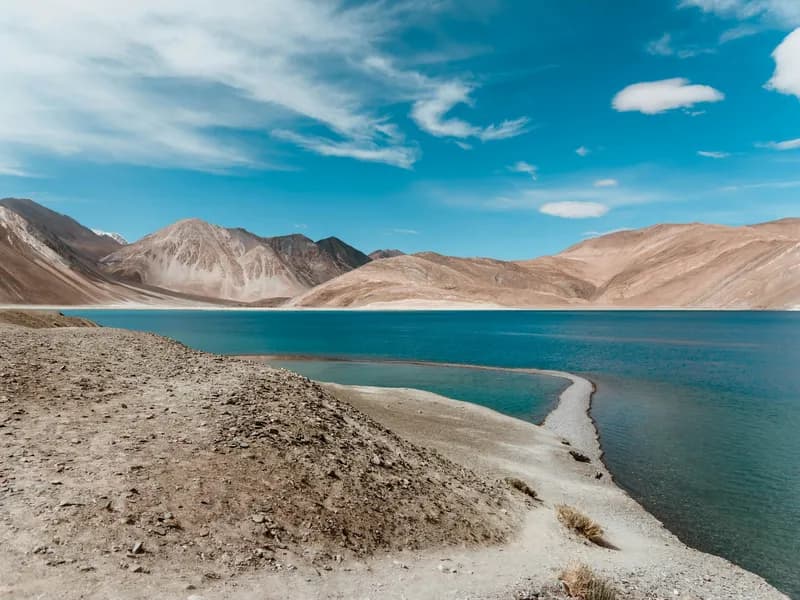
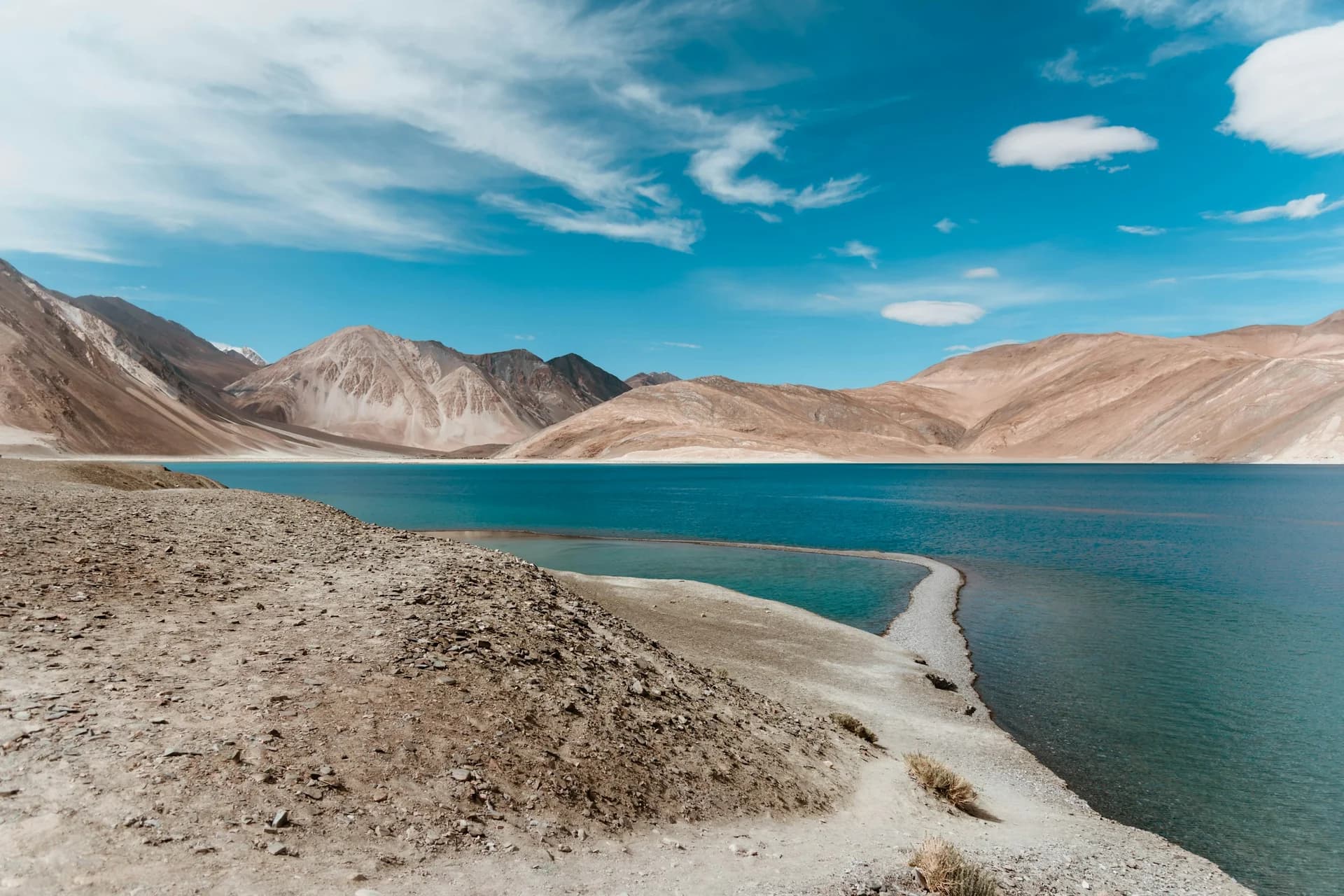
You've seen the photos. You've seen the Bollywood scene ("3 Idiots" was filmed here). None of it prepares you for the actual color. The lake is turquoise. Not the Instagram-filter turquoise of tropical beaches. A deep, metallic turquoise that seems to come from inside the water rather than reflected off its surface.
Pangong Tso is 134km long and extends across the border into China. At 4,350 meters (14,270 feet), it's one of the highest saltwater lakes in the world. The mountains surrounding it are brown and barren — no trees, no vegetation, nothing but rock and sky and water, the same high-desert palette that defines Spiti Valley, Ladakh's quieter cousin over in neighboring Himachal.
The silence at Pangong is the most aggressive silence you'll ever experience — nothing like the birdsong and paddle-splash of a gentler, lower Himalayan lake town like Pokhara. There's no wind sound because there are no leaves to rustle. No insects. No birds at the lakeshore (though bar-headed geese and Brahmin ducks are seen at the eastern end). Just the faint lapping of water on gravel.
Stand at the shore for fifteen minutes and you'll catch yourself holding your breath — not from altitude, but from trying not to make any noise that would break the silence.
Tent camps line the lakeshore: 2,500 INR ($30) with dinner and breakfast. The tents are basic — mattress on the ground, blankets, a solar-powered lamp. The communal toilet situation is, let's say, character-building. No running water. No electricity after 10PM.
But step outside at 3AM and look up. The Milky Way runs from horizon to horizon. No light pollution for 50km in any direction. Standing there in 2°C cold, in your socks, staring at more stars than you knew existed — that's when you understand why people keep coming back.
The Return
Day 7: the drive back to Leh. Six hours of mountain roads, military checkpoints (carry your Inner Line Permit — 600 INR / $7.20, processed at the DC office in Leh), and one more pass above 5,000 meters.
Back in Leh, order thukpa (Tibetan noodle soup) at a restaurant near the main bazaar — 120 INR ($1.44) for a bowl that warms you from the inside out. The altitude doesn't bother you anymore. Your body has adjusted. Your lungs have expanded. Your pace has slowed.
Tashi-la was right. By Day 7, you feel Ladakhi — or at least the version of yourself that Ladakh produces: slower, quieter, more willing to stand at a lakeshore and hold your breath.
Ladakh doesn't have beaches. It doesn't have nightlife. For those seeking spiritual India, Varanasi and Rishikesh offer a different kind of depth. The food is functional rather than revelatory. The roads will damage your spine. The altitude will give you headaches.
And none of that matters. Because at 14,000 feet, standing next to a turquoise lake with the Milky Way overhead, you stop keeping score.
That's what altitude does. It takes away the noise — literally and metaphorically — and leaves you with whatever's underneath.