The Deer Bowed and I Lost It: Three Days in Nara, Japan
The Deer Bow First: Three Days in Nara, Japan
The Kintetsu train from Kyoto takes 35 minutes. Thirty-five minutes from the chaos of Shijo-dori — the crowds at Fushimi Inari, the taxi queues at Kyoto Station, the influencers blocking the bamboo grove — to a small city where deer wander through temple grounds and the loudest sound is a wooden bell.
Plan Nara as a day trip and everyone will tell you the same thing: "Half day. Temples, deer, done by lunch."
Give it three days. You'll understand why.
The Arrival
Kintetsu Nara Station drops you on Sanjo-dori, a shopping street that looks like every mid-size Japanese city — convenience stores, souvenir shops, a Starbucks, the same run of frontages you'd walk past under Nagasaki's covered arcades. Nothing suggests you're about to walk into something ancient.
Then you turn east toward Nara Park, and the city just... stops. The concrete gives way to grass. The noise fades. And there, under a massive camphor tree, stands a deer. Just standing. Looking at you with enormous brown eyes, ears forward, completely unbothered.
Nara has over 1,200 sika deer living in and around the park. They're classified as national treasures — the same reverence shown to the wild deer that roam the shrine island of Miyajima. Legend says a deity rode into town on a white deer in 768 CE, and the animals have been sacred ever since. They roam freely — through the park, across roads, into convenience store parking lots. Traffic stops for them.
Buy a stack of shika senbei (deer crackers) from a park vendor for 200 JPY ($1.34). Hold one up. The deer in front of you lowers its head and bows. A proper bow — head down, pause, head up.
It's a learned behavior, of course. Generations of deer figured out that bowing gets you crackers. Pure Pavlovian conditioning. Nothing mystical about it.
And yet — standing in a park that has existed for 1,200 years, with a wild animal performing a gesture of mutual respect before accepting food from your hand — something in your chest goes quiet. It's the gentleness of it. The trust.
Three crackers in, six more deer appear. These are not gentle. One will headbutt your hip. Another will eat the paper bag. You learn to distribute quickly.
Day 1: The Buddha That Resets Your Sense of Scale
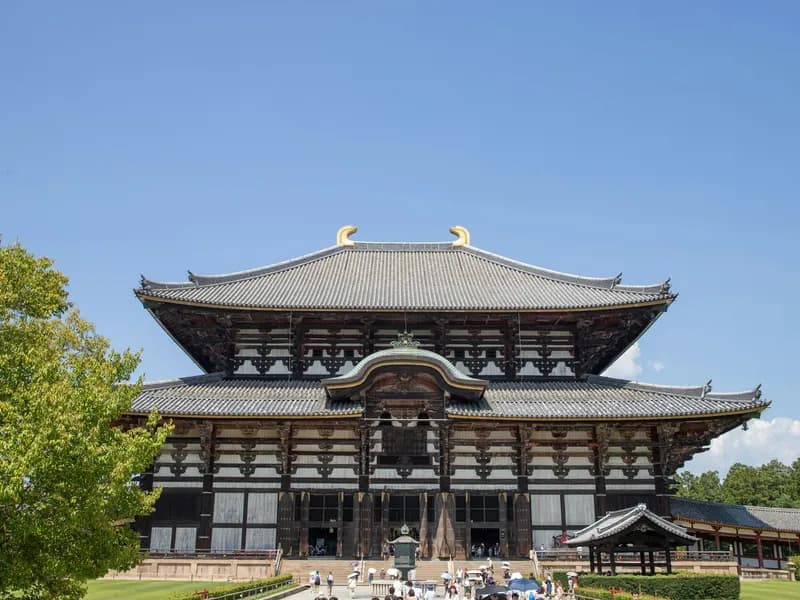
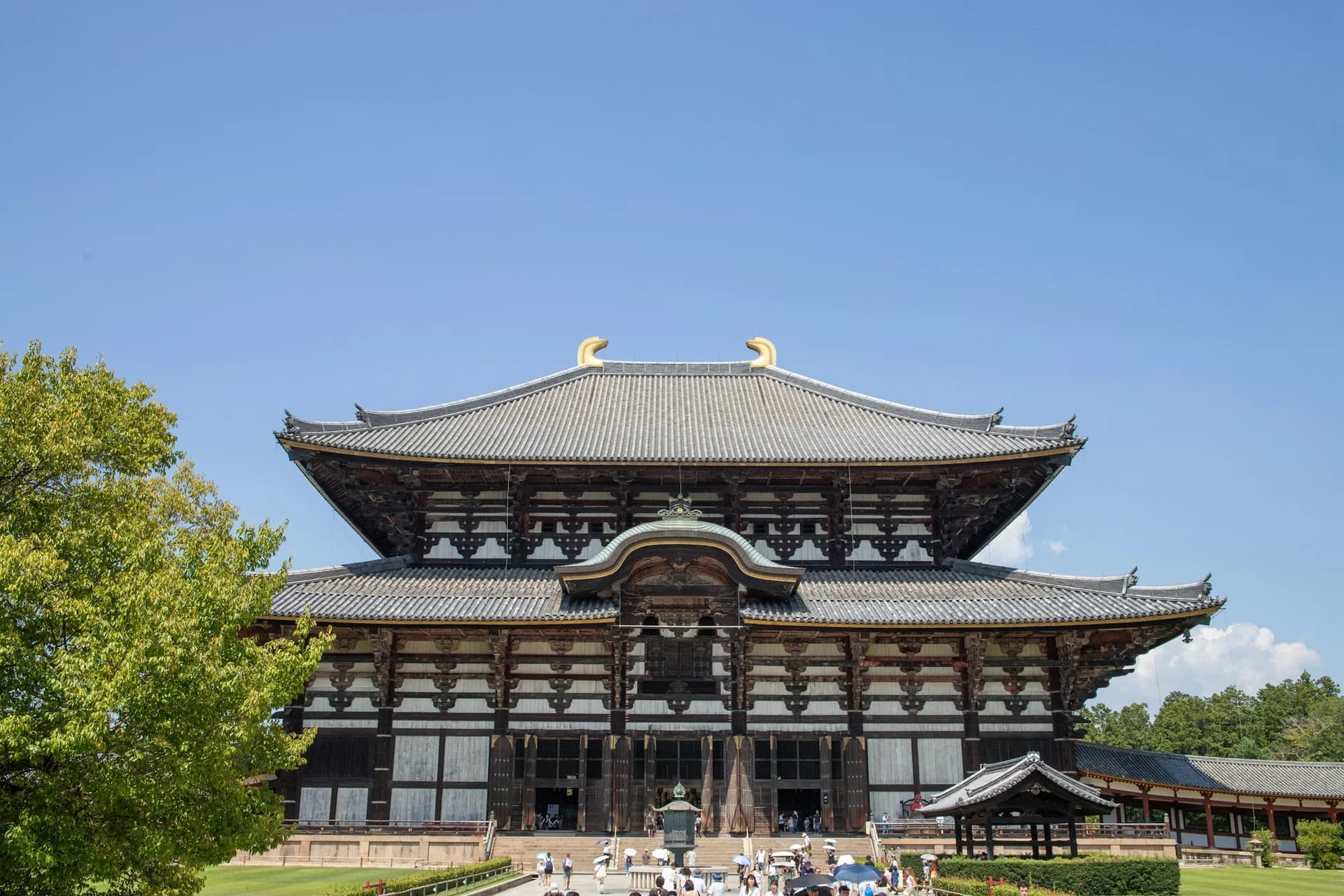
Todai-ji's Great Buddha Hall is the largest wooden building in the world. Easy to read on a page. Much harder to process until you're standing inside it, working out what "largest wooden building in the world" actually means.
You walk through the Nandaimon — a gate flanked by two 8.4-meter guardian statues carved by Unkei and Kaikei in 1203. Sixty-nine days. They carved those statues in sixty-nine days. Each muscle fiber is visible. The expressions are furious. The scale is meant to intimidate, and 800 years later, it still works.
Past the gate, across a courtyard, the Daibutsuden rises. Gray wood, massive eaves, a roofline that curves upward at the corners like a wave about to break. Step inside.
The Daibutsu — Vairocana Buddha — sits 15 meters tall, cast in bronze, weighing 500 tons. The casting happened in 752 CE and used most of Japan's copper supply. The Buddha's right hand is raised in a gesture of fearlessness. The left palm faces upward in a gesture of granting wishes. For comparison, the Great Buddha at Kamakura — Japan's other iconic Daibutsu — sits out in the open air, its wooden hall washed away by a tsunami centuries ago, which makes Nara's decision to enclose its Buddha inside a building at all feel like a deliberate choice.
Stand at the base and look up. Your neck cranes back. The head sits so far above you that the details of the face — the curled hair knots, the half-closed eyes, the slight smile — blur at the edges. The scale doesn't compute in a photograph. You need to be inside the building, dwarfed by it, to understand what the Nara court was trying to say.
What they were saying, it seems, is this: this is permanent. This matters. We are building something that will outlast us.
It did.
Day 1 (continued): Kasuga-taisha at Dusk
From Todai-ji, a path winds south through the park into the primeval forest surrounding Kasuga Grand Shrine. The trees — centuries-old cedars and camphor — form a canopy so thick that the temperature drops five degrees. The light turns green-gold. Moss covers everything — the kind of ancient, cedar-and-moss old growth you otherwise have to sail all the way to the primeval forests of Yakushima to walk through.
Kasuga-taisha's approach is lined with stone lanterns — approximately 2,000 of them, donated by worshippers over centuries. Some are pristine, recently maintained. Others are consumed by moss, their inscriptions worn smooth. Deer weave between them, nibbling grass.
The shrine itself is Shinto — red-orange painted wood, white paper streamers (shide), a sense of emptiness that is the opposite of Todai-ji's overwhelming presence. Where the Buddha demands attention through scale, Kasuga achieves it through absence. The inner sanctum is mostly empty space. You feel the space more than any object in it.
Arrive at 4:45PM. The shrine closes at 5PM in autumn, so you'll be nearly the last person there. A shrine maiden (miko) in white and red robes crosses the courtyard carrying a wooden offering tray. Her footsteps echo.
This is what day-trippers miss. The last light. The emptying. The transition from "tourist site" to "active shrine" as the crowds leave and the shrine prepares for evening rituals.
Day 2: Horyu-ji and the Weight of Wood
Take the 8:15AM JR train to Horyuji Station (12 minutes, 220 JPY / $1.47) and walk 20 minutes through a residential neighborhood to reach the temple.
Horyu-ji's Western Precinct contains the oldest wooden structures in the world. The five-story pagoda dates to approximately 607 CE — though debates about exact dating continue. Whichever century you assign it, this building has been standing for over 1,300 years. Wood. In a country with earthquakes, typhoons, and humidity.
The pagoda's secret is a central pillar (shinbashira) that hangs from the top and acts as a pendulum counterweight during earthquakes. It doesn't support the building — it stabilizes it. Tokyo Skytree uses the same principle. Ancient engineering solving a modern problem.
Give Horyu-ji two hours. In that time, maybe thirty other visitors pass through. Compare that to Todai-ji's thousands. The quiet is part of the experience — the same trade you get in Gyeongju, Korea's old Silla capital, whose eighth-century temples rarely draw Todai-ji's crowds.
The museum (included in the 1,500 JPY / $10.05 entry) contains Buddhist art that would be the centerpiece of any major museum in the world. The Kudara Kannon — a 2-meter-tall wooden Bodhisattva with an impossibly slender body and enigmatic smile — holds you for ten minutes. The wood grain is visible through the faded paint. You can see the chisel marks.
Day 3: The Gardens and the Goodbye
Save the last morning for Isuien Garden at opening (9:30AM, 650 JPY / $4.35). Isuien uses borrowed scenery — shakkei — incorporating Todai-ji's Nandaimon gate and the hills of Mount Wakakusa into the garden's composition. It's a smaller, subtler cousin to the grand stroll gardens like Kenrokuen up in Kanazawa. The garden doesn't end at its walls. It extends to the horizon.
The east garden has a pond with a strolling path. Koi surface for food pellets. The west garden is smaller, more intimate, designed for tea ceremony. Sit on the tatami floor of the tea house overlooking the pond and order matcha with a wagashi (seasonal sweet) for 600 JPY ($4.02).
The matcha is bitter. The sweet is shaped like a maple leaf — momiji, October's symbol. The garden frames Todai-ji's gate in the distance.
Sit there for 45 minutes. Nothing happens. No phone. No photos. Just sitting.
In the afternoon, wander Naramachi, the old merchant district south of Sarusawa Pond. Machiya (traditional wooden townhouses) converted into cafes, craft shops, and small museums — the same lattice-fronted architecture preserved wholesale in the old town of Takayama. Pick up a tenugui (hand-dyed cotton cloth) with a deer pattern for 1,200 JPY ($8.04). Have kuzu mochi (arrowroot starch jelly) at Nakatanidou — the shop where the mochi-pounding performers run their famous high-speed routine.
The Verdict
That "half day" advice is wrong. You can't do Nara in half a day. You can see Todai-ji and pet some deer in half a day, sure. But that's like saying you can "do" Paris by visiting the Eiffel Tower and eating a croissant.
Nara deserves three days minimum. It deserves early mornings before the day-trippers arrive and late afternoons when the shrines empty and the deer settle into the grass for the evening.
The deer bows on Day 1 and something opens. By Day 3, sitting in a garden watching a 1,300-year-old gate frame the mountains, that opening has widened enough to let something through.
Call it presence. The quality of being somewhere that has existed for so long that it teaches you, through sheer duration, to slow down.
Plan a return trip. Spring, for the cherry blossoms in Nara Park, which open weeks before the same front reaches Hokkaido's capital — though honestly, any season rewards you.
The deer will be there. They've been waiting for 1,200 years. They can wait a little longer.